Sunday, June 04, 2017

Lookalikes #39: Henry Darger and Marcel Dzama

I've written about Henry Darger previously; Marcel Dzama is a contemporary artist who also works in scultpure, film and collage. His paintings have adorned album covers, he's had books published. Henry Darger, outsider artist, was a caretaker and hermit, creating his deeply personal art in his apartment at night. I love both Darger and Dzama, but almost can't imagine Dzama's art existing if it wasn't for Darger.

Previously on Barnflakes:
Lookalikes #12: Feels and Henry Darger

Thursday, June 01, 2017

Top ten influences in my life

1. e e cummings (poet)
2. Sandra Bernhardt (woman)
3. Buddhism (religion)
4. Bacon (meat)
5. Luis Bunuel (Spaniard)
6. The 07:52 to Waterloo (transport)
7. Ferris Bueller's Day Off (film)
8. Noam Chomsky (American)
9. Akzidenz-Grotesque (typeface)
10. Jeremy Corbyn (man)

Wednesday, May 31, 2017

Two dreams

1.
I was at a sort of jumble sale in a 1970s-style council building. I saw a bunch of records that a woman had just bought. She was half-way between a landlady I had in Sydney and an old school friend who lives in Cornwall; she was a hippy, with a kind of satisfied look about her, though she was looking flustered at first. I noticed I owned some of the records she'd bought; in particular I saw a boxed set of The Cream of Eric Clapton (which I don't own, and which actually doesn't exist as a vinyl box set) and asked her about it. I told her I had it at home, along with some of the others, and asked if my parents had taken my records and bought them to the jumble sale. She said no. I asked if I could look through the pile. She let me, and I noticed some Procol Harum and Layla and Other Assorted Love Songs by Derek and the Dominos (ie Eric Clapton).

Then it seemed like I was getting a lift with her and some of her children. I gathered she was a kind of teacher. We arrived at her house in the countryside, which looked like a ramshackle boarding school. Children were everywhere, and a brother and sister took a shine to me and showed me round. It was then I noticed the children turning into various animals and birds. Foxes, badgers, birds, insects. They made a hand movement when they changed, there was a sparkle in the air, then they were an animal. I had to make a phone call, from an old red phone box in the huge garden. I couldn't get through. One of the children told me I could change if I wanted, into a bee. How? I asked. He showed me the hand movements, Like this, he said. I was about to do it, my cat jumped up on the bed and meowed in my face, and yes, of course, I woke up.

What can I say? Production values weren't high; it looked like it was shot on 16mm then transferred to VHS, but that was part of its charm. There was a magical yet eerie lyricism about the dream. It felt like those great 1970s BBC kid's programmes – The Owl Service, The Changes, Children of the Stones. Acting was good, natural. Special effects, not bad for the time – kids turning into animals.

I had a late breakfast; scrambled eggs and caviar on toast, a pot of proper coffee. Life wasn't bad. The cat meowed, wanted feeding.

Previously on Barnflakes:
Children of the 1970s

2.
The 13-year-old boy had expensive camera gadgets plus a drone. I hid them from him under a rug. He asked me where they were. Stolen I said. Oh no he cried. He told his parents and they called the police. The police couldn’t find them until I tried to move them. They caught me and I went to jail. The boy filmed me in jail with his phone and put the video on YouTube. The video got millions of hits and made him a YouTube superstar. I got out of jail and filmed myself watching his video of me in jail on YouTube, then filmed myself smashing up my phone, then uploading the video. It got like 2 or 3 hits.

When I'm happy and busy, I never remember my dreams. When I'm listless and despondent, I have really vivid dreams, such as these.

Previous dreams here.

Tuesday, May 30, 2017

Banning bags on London transport

In a controversial move to ease congestion on London's over-crowded travel network, officials have announced the banning of all bags on trains, tubes and buses, estimating this will free up 39% of space on the networks. Rucksacks in particular take up the space of one person, a TFL official explained, and are extremely annoying, seeing as the oblivious owners whack other people with them when they turn around. "At worst rucksacks present a security issue and may contain an explosive device; at best they contain pointless clutter – either way they are a nuisance", the same official explained.

Free transport!
It would seem churlish not to take advantage of the endless engineering works besetting the rail network. So, travel for free! The replacement buses and coaches put on never check tickets, so hitch a ride for free, even if it's not to where you want to go, even if it does take four times as long as the train. 

A while ago I had to endure a bus replacement ride to Fleet in Hampshire. The train from Clapham Junction to Fleet usually takes 45 minutes; the replacement bus got lost and took nearly four hours. Still, it was a free journey, and I enjoyed seeing countryside I'd never seen before.

Previously on Barnflakes:
See it. Say it. Sod it
Public transport courtesy cards
Pet hates #1,287: the rucksack

Monday, May 29, 2017

Two Random ADHD Film Reviews

Two films where the lead teenage boys both suffer from attention deficit hyperactivity disorder (ADHD); neither film is exactly cheery but both are superb, extremely moving and rewarding.

THE SELFISH GIANT
Dir: Clio Barnard / 2013 / UK / 91mins.
If the title sounds like it might be a Roald Dahl tale, put that thought away – it is actually more Dickensian than Dahl. Loosely based on Oscar Wilde's story of the same name, the film is set in modern day Bradford, in deprived, slum estates that are reminiscent of Don McCullin's photos of Bradford in the 1970s. The film follows two teenagers, the hyperactive and out-of-control Arbor (whose name made me think of the film The Arbor; then I discovered both were directed by Clio Barnard) and the slow and sensitive Swifty. After being suspended from school, the boys start making money by roaming the streets collecting scrap metal and selling it to a local dealer, Kitten.

Presumably the selfish giant of the title, he is played with relish by Sean Gilder (of Shameless fame), a Fagin-type character and monster, illegally employing and exploiting local children desperate to make a few pounds. Kitten also competes in local, illegal, horse harness racing, and when he finds out Swifty has a way with horses, Kitten gets him to ride his horse to compete in the races. There is not a nice bone in Kitten; he constantly shouts, swears, threatens and hits the kids. His scrapyard is his castle and it's like a vision of Hades, all fire and metal.

A social realist film in the British tradition, by which I mean depressing, it is alleviated by the remarkable acting of the two young leads and their shifting friendship; the poetry for the countryside and a terrifyingly exciting horse race along a motorway at dawn. Near the end the tragic and shocking denouement is only exonerated by the last few scenes in the film, and the final shot, the only glimpse of sentimentality in the film, but by this point a bit of sentimentality is allowed and deserved.
– 5/5

MOMMY
Dir: Xavier Dolan / 2014 / Canada / 138mins.
Being filmed in a 1:1 ratio (i.e. square) made me immediately think of Instagram but this apparently wasn't the intention. The intention was to create a private, repressive, enclosed world, which the film does. The screen opens up to wide screen twice, for about five minutes each time. The first time, halfway through the film, has Steve actually pull the screen wide open. He's running along the middle of a busy road with a shopping trolley full of groceries wearing large white headphones with Oasis's Wonderwall playing on the soundtrack; it's one of the most thrilling moments in the film. Music is key to the film – as a form of escape and release. I didn't want the scene to end, or the screen ratio to return back to 1:1, but knew it would.

Steve is the son of the eponymous Mommy of the film, a charismatic but violent and extremely anti-social teenager. Released from juvenile detention centre for setting fire to the cafeteria, it is up to hard-as-nails mommy, Diane, to look after her son and try to hold down a job. Kyla, a neighbour from across the street – a shy teacher with a stutter on a sabbatical – helps to school Steve, and the three form an unlikely yet inseparable trio.

Mommy contains some of the most exhilarating scenes of anti-social behaviour combined with music I've seen for years. And not necessarily good music – Celine Dion, The Counting Crows, Dido, Sarah McLachlan and Andrea Bocelli all populate the decidedly unhip soundtrack. Nevertheless, the mix of ballads and pop create an emotional escape to the difficult situations in the film  – Steve's violent and outrageous anti-social displays are contrasted with dreamy, slow motion, music video-like sequences full of hope and happiness.
 – 5/5

I have no opinion or expertise on ADHD; both films suggest it stems from poverty and lack of a father figure; I wouldn't know. That the only solution seems to be pills and institutions I would disagree with – these don't address the core of the problem, only mask it. Cognitive behavioural therapy is a better alternative.

Previously on Barnflakes:
The lost art of the double bill 
Notes on afflictions
Top ten affliction films
Stuttering in the movies

Sunday, May 28, 2017

The Rayfaring Stranger

 
For Ray on his lonesome wayfaring travels.

Friday, May 26, 2017

The lost art of the double bill

A Google search of the term 'double bill' reveals the Everyman cinema showing a double bill of Guardians of the Galaxy along with the 'amazing' Guardians of the Galaxy Vol. 2. Now, the last time I saw a double bill at the Everyman it was two Japanese erotic classics in the 1980s: Woman of the Dunes plus Ai No Corrida (yes, I've mentioned this before). Times have changed. Double bills used to have imagination, they used to make you think about the connection between the two films. They could complement each other, or be at odds with each other. The relationship might be opaque or tenuous. You might not have even heard of one of the films. Good!

Anyway, here's ten of my own double (and quadruple – this would usually be an all-nighter) bills:

Retired Cops With A Nagging Hunch No One Listens To:
THE PLEDGE (2001) + HELL OR HIGH WATER (2016)

The River Journey Is The Destination: EMBRACE OF THE SERPENT (2015) + APOCALYPSE NOW (1979)

Maverick Directors Go Normal: PATERSON (2016) + THE STRAIGHT STORY (1999)

Social Comment Ensues When Aliens Land In The U.S.A:
THE BORROWER (1991) + BROTHER FROM ANOTHER PLANET (1984)

Writer & Artist Retreats: ARCHIPELAGO (2010) + TAMARA DREWE (2010)

National Geographic Photographers Having Affairs In Faraway Places: THE BRIDGES OF MADISON COUNTY (1995) + GORILLAS IN THE MIST (1988)

Twisted Relationships In The Manor: ADELHEID (1969) + THE DUKE OF BURGUNDY (2014)

Transformations: PHOENIX (2014) + SECONDS (1966) + VERTIGO (1958) + EYES WITHOUT A FACE (1960)

We're Watching You: THE TRUMAN SHOW (1998) + BATTLE ROYALE (2000) + THE RUNNING MAN (1987) + HUNGER GAMES  (2012)

Depardieu Eats Meat: WELCOME TO NEW YORK (2014) + LOULOU (1980)

Previously on Barnflakes:
Double Bill Me
Scala Forever!

Thursday, May 25, 2017

Alton estate of mind – the book


The Alton estate of mind book(let) is finally finished. It's a personal and architectural guide to the Grade II listed Alton estate in Roehampton, where I lived many years ago. The text is mainly the same as on this very blog (see here); some of the photos are on Flickr. But there's nothing like  holding a book (or going to an exhibition). You know, the physical, tactile thing. I still have to get it printed, mind. Watch this space (again).

Wednesday, May 24, 2017

Yellow parrots on pylon

Okay, I admit it. I regularly look at the website Pylon of the Month. And I'm old enough to remember the BBC series The Changes, with its fear of pylons (referred to as 'bad wires'). The parrots? Dunno, just looked like it needed a splash of colour.

Saturday, May 20, 2017

The Morris Dance Murders Movie

I’ve always been slightly afraid of the pagan, cultish and violent aspects of Morris dancers so it came as a delight to come across The Morris Dance Murders, a little-known, low-budget cult British horror film from the early 1970s. Starring no one famous and directed with surprising aplomb by first-timer Vivian Cluster, who seemed to vanish after the making of the film, it displays a mastery of British landscape seen only from Michael Reeves (Witchfinder General) and Nicolas Roeg (cinematographer of Far From the Madding Crowd, as well as director of such classics as Performance and Don't Look Now) around the same period. It echoes those films, and of course The Wicker Man, in its depiction of British ritual and tradition gone astray.

Set in the middle ages, the plot focuses around a troupe of Morris dancers who travel from village to village murdering random folk, then each other, with ever-increasing inventive ways (à la Dario Argento) using batons and handkerchiefs. Expect certain staples from Hammer Horror such as busty barmaids and some cranky acting, but be surprised at the lush photography, the attention to period detail and some fantastic set pieces. It's also pretty scary without being gratuitous.

Wednesday, May 17, 2017

William Blake's vision of angels in Peckham

Top: possible oak tree planted in honour of Blake; bottom: Blake mural at Goose Green
It takes almost as much imagination as artist and poet William Blake had to picture him, aged 7 or 8, walking to Peckham Rye on his own and having his first (of many) vision of angels there, but that's how the story goes: "A tree filled with angels, bright angelic wings bespangling every bough like stars". Around 1765 the boy William, not liking built-up central London where he lived, liked nothing more than to walk seven miles or more (sometimes as far afield as Croydon) to the common at Peckham Rye. One Blake scholar says these formative walks had a strong influence on future poems such as Songs of Experience.

Locating the actual tree is impossible now; for one thing the common was a lot larger than it is now, for another, even if it's still there, does it actually matter? We had enough trouble tracking down the small oak tree that was planted in 2011 by artist John Hartley in honour of William Blake (there's no plaque or sign, and we had only had a vague map of the park with a red cross where the tree is. It was a case of not being able to see the tree for the trees). Nearby, on Goose Green, there's a mural to Blake's vision of angels, painted in 1993 as a community project.

(Did we see any angels? was the inevitable question asked us when we returned from our wanderings. Well, actually yes. I thought I spotted one on the common, but it was a dead tree. But we saw them on the mural, and then in Nunhead cemetery, our next stop.)

Tuesday, May 16, 2017

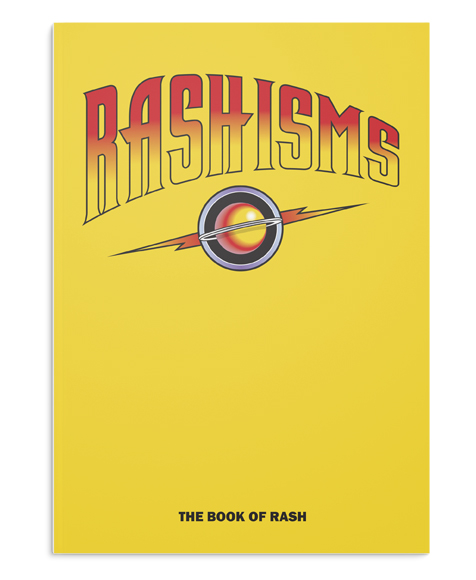
Rashisms: The Book of Rash

My friend and colleague Rashpaul passed away almost two years ago, and he is still sorely missed by many. I've been meaning to create a book of his sayings and hilarious photo montages since he died. I finally have, and will be printing it soon. Watch this space.

Previously on Barnflakes:
Pulp Poetry posthumously published